Roje Khalique | Consultant CBT Psychotherapist in London
Specialist in South Asian & BAME Professional Mental Health
I'm a BABCP-accredited Consultant Psychotherapist working with Black, Asian, and minority ethnic professionals navigating workplace pressure, cultural expectations, and identity. I have particular expertise supporting South Asian and bi-cultural clients at the intersection of Eastern and Western values.
Before training as a therapist, I worked in the City of London alongside investment professionals. I've since supported NHS medical staff, employees at leading law firms, and diverse professionals experiencing anxiety, burnout, and the unique pressures of navigating corporate environments while carrying complex cultural identities.
Living Between Worlds
I was born and raised in London, with South Asian heritage and a faith tradition rooted in the Middle East. My life has always sat at the intersection of cultures, languages and belief systems. I don't just understand bi-cultural identity in theory, I've lived the reality of moving between different cultural operating systems every day.
I know what it is to feel like an outsider in one setting and completely at ease in another, sometimes within the same day. For a long time, I thought not fully fitting into any one group was a problem to fix. Over time, I realised it was a source of strength: it built adaptability, emotional range, and the ability to see patterns that people rooted in just one world often miss.
That's the perspective I bring to my work, especially with bi-cultural and trilingual professionals trying to harmonise different parts of their lives without erasing themselves through assimilation or separation. I'm not aiming to squeeze you into a single identity. I'm interested in how your different worlds shape you, and how that complexity can become an asset rather than something you quietly work against.

How I Work With South Asian & Diaspora Professionals
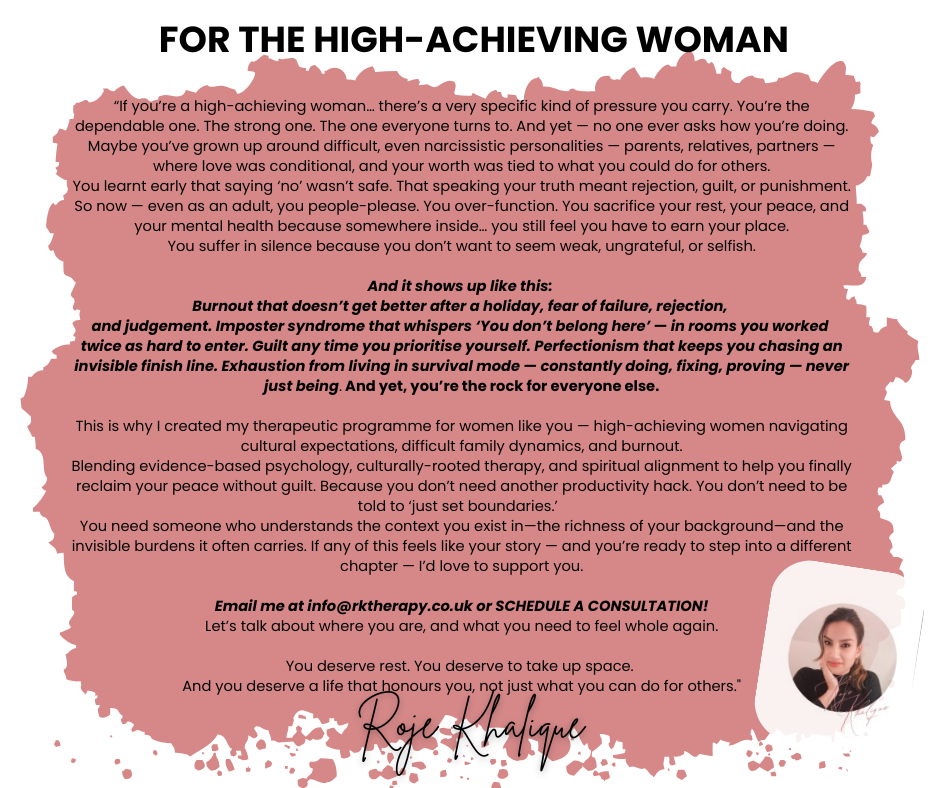
At rkTherapy, we work with high-achieving diaspora professionals, particularly South Asian and bi-cultural clients, whose lives sit at the intersection of culture, ambition, and emotional responsibility.
You were raised with powerful truths: family comes first, respect your elders, don't bring shame, excellence is expected not celebrated. In Eastern collectivist cultures, you were taught to give, to sacrifice, to forgive, to honour, to hold your tongue. Those values helped you become resilient and accomplished. They also taught you, quietly, that your needs come last.
You've worked hard for everything you've achieved, often inside systems that weren't designed with your story, body, or surname in mind. Your journey has taken persistence, intelligence, and quiet determination. Those qualities deserve to be honoured, not drained.
What we address in therapy:
In this work, we look at what happens when those early rules meet Western achievement culture and modern workplaces. You will learn to recognise when people-pleasing and over-giving, sometimes praised as "seva" or mislabeled as "sabr", start to harm your mental and emotional health. We explore how expectations around family obligation, respect for elders, and community reputation shape the way you make decisions, carry guilt, and silence yourself. Utilising our signature Diaspora Intelligence® framework and Culturally Adapted CBT (Ca-CBT), we provide the psychological and sociological tools to help you navigate these competing worlds with clarity and authority.
Together, we trace how intergenerational trauma, migration, racism, and cultural pressure have shaped your nervous system and identity, not to blame culture or family, but to give you a clearer map of what you're carrying.
Our approach helps you step out of patterns such as:
- Narcissistic or controlling dynamics disguised as "respect" for authority, parents, or partners
- People-pleasing framed as duty or service that leaves you depleted and still feeling "not enough"
- Perfectionism driven by both Western performance culture and Eastern ideas of family honor
- Burnout from compassion fatigue and the invisible mental load of moving between conflicting worlds
- Persistent self-doubt and "imposter" feelings despite clear external success
- Lack of healthy boundaries justified as cultural obligation and fear of "log kya kahenge"—"what people will say"
- A lifetime of guilt for wanting to protect your wellbeing and follow your own path
This is not about rejecting your culture. It's about understanding the operating systems you inherited so you can live within them, or alongside them, with a stronger sense of who you are—not just who you are expected to be.
Professional Background
Relevant Experience & Qualifications:
- BABCP Accredited Cognitive Behavioural Psychotherapist
- 20+ years of experience in mental healthcare settings
- 15+ years specialising in CBT and psychological therapies, including extensive work with BAME
- Former City of London finance professional
- Supported NHS medical staff during COVID-19 pandemic and lockdowns
- Provided mental health services addressing stress, anxiety, and burnout for a Magic Circle law firm
Published Work:
As co-author of two U.S. anthologies, Taboo: Stories That Can't Be Told and MENtal Health: Take It Like a Man, I've explored masculinity and the scripts we inherit. In Taboo, my chapter "The Power of Not Fitting In" examines how difference becomes strength. In MENtal Health, "Breaking the Code" looks at what happens when high-achievers question inherited definitions of success.
My practice operates uniquely at the intersection of psychology, sociology, and bi-cultural identity, looking at mental health through both an individual and systemic lens. I combine evidence-based CBT with health psychology, addressing how racial trauma, workplace discrimination, and intergenerational patterns affect mental health for South Asian and diaspora professionals.


Ready To Start?
Schedule a Consultation or Contact us at [email protected]
Available in-person in London or via secure video-call